Yay! This needs no comments! Magic World of Blue Lake photo by Viktor Lyagushkin wins week 3 National Geographic Traveller Photo Contest
National Geographic Traveller Photo Contest
Reply



Yay! This needs no comments! Magic World of Blue Lake photo by Viktor Lyagushkin wins week 3 National Geographic Traveller Photo Contest
 Stoneworts — an ancient class that combines the attributes of algae and higher-order plants — serve as a source of food for waterfowl, especially during autumn migrations.
Wrapped in a weightless veil of cladophoraceae algae —
poetically named mermaid’s hair — stoneworts adorn this 260-meter-deep karst lake, their mild radiancy juxtaposed against the gloomy rock walls of the deep. When exposed to sunlight or strobes, stoneworts start to shed their own light. This phenomenon is known as photoluminescence, and lasts for only a fraction of a second.
HOW I GOT THE SHOT I used a Nikon D3s, 60mm, f/2.8, Subal housing, and two Ikelite DS160 substrobes mounted on the camera.
Where: Blue Lake, Kabardino-Balkaria, Caucasus, Russia
by Viktor Lyagushkin
Look Section, Scuba Diving Magazine (USA) March/April 2013
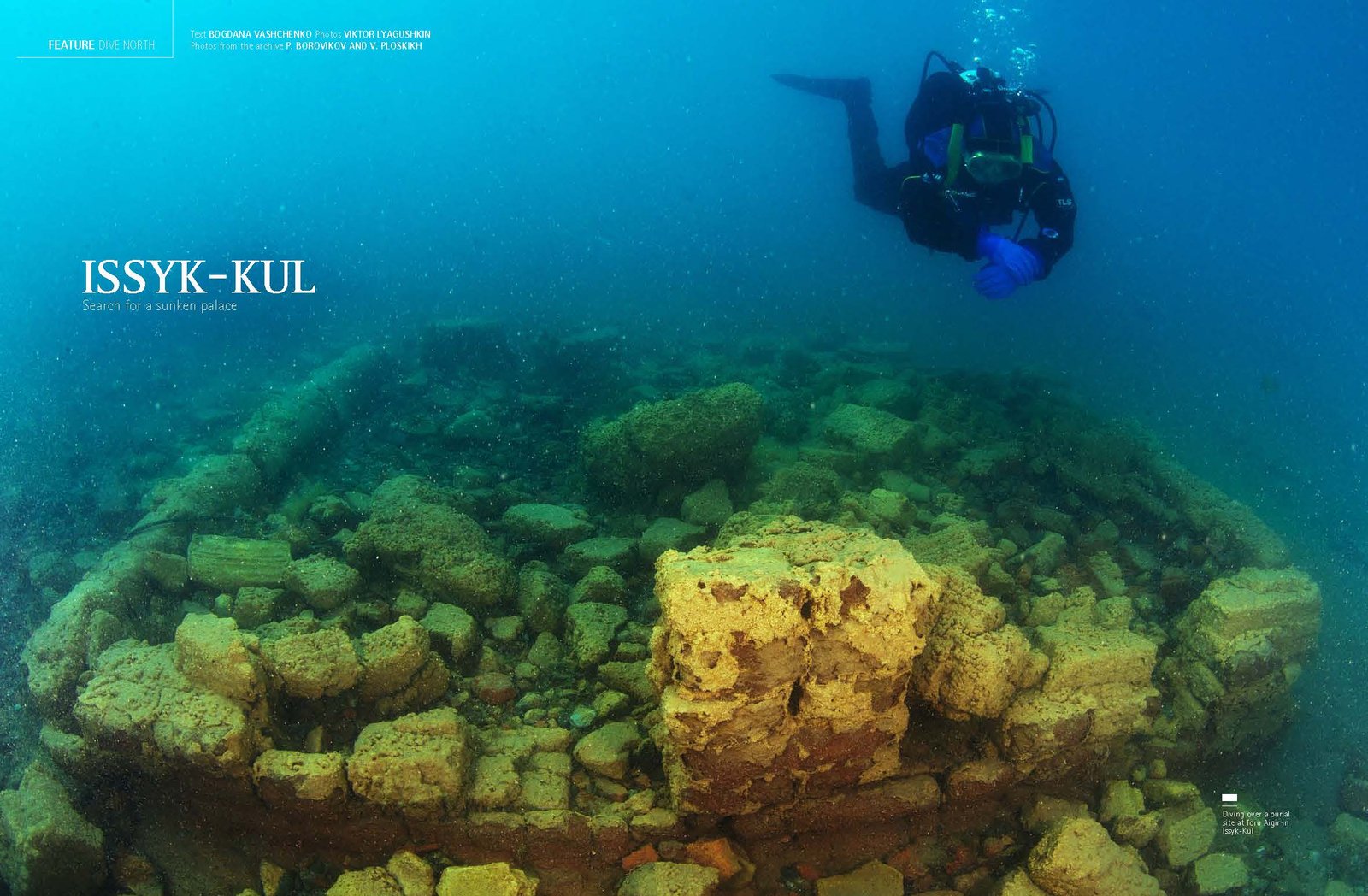 A big 9-page piece about history of underwater archaeology at the Issyk-Kul lake in Asian Diver Magazine, 2012, Issue 6, Volume 123
“The history of Lake Issyk-Kul is littered with secrets. It is said that nearly 1,500 years ago, a Chinese Buddhist monk went on a pilgrimage to India. Overcoming difficulties and dangers, the traveller came to a big lake about four miles into the mountains. This was the Issyk-Kul Lake, sitted amidst mountains and taking income from numerous rivers. The monk described the lake as being greenish-black, salty and bitter. Its sweeping waves would at times rise and attack the shore with irresistible force. The lake, said the monk, is home to dragons and fish, and sometimes, extraordinary monsters appear from the depths. That’s why travellers pray for others and their own welfare. While the inhabitants of the lake are numerous, no one dares to catch any.
But it is impossible to quash human curiosity and the thirst for knowledge. Since the 19th century, Russian scientists have been studying the ancient remains around Issyk Kul, which range from petroglyphs and 3,000-year-old kurgans (nomadic burial mounds) to early Christian monasteries and medieval cities. The lake itself also drew attention from researchers pertaining to certain remains that lie beneath its stunning cobalt waters.”
 Orda Cave again in Photoexpedition section of National Geographic Russia Magazine, March 2013.
Orda Cave has been featured among  the best world’s underwater caves according Scuba Diving Magazine.
Text: Bogdana Vashchenko, photo: Victor Lyagushkin.